

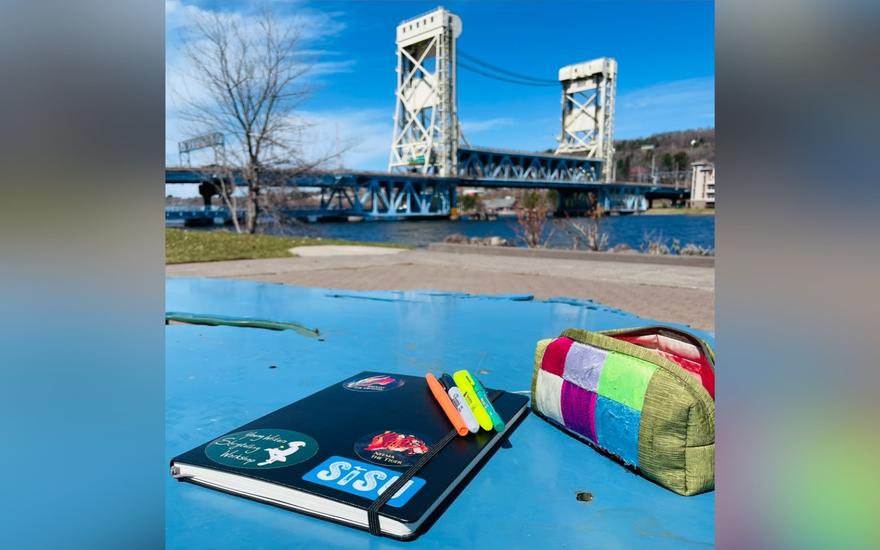
As writers, we need to constantly replenish our well of creativity. We must have both inspiration and stamina to see projects successfully come to completion. This is not always an easy task, and there are many places that we can get stuck—idea generation, organizing pieces, cleaning up details, or presenting the work to the wider world. In order to avoid the many possible roadblocks, it is good to have practices that help us figure out how to get unstuck. Here is one technique I use that combines prayer and meditation with journaling.
Before I begin, there are many ways to pray, meditate, and journal. It is very personal, so each of us must experiment and find what works best in our own lives. At the end, I have a brief note with more information about how I pray, meditate, and journal. The most important point is that we can use prayer, meditation, and journaling in a process to overcome difficult problems.
Here are the steps that I follow:
First, I take out my journal and open to a new, clean page. I write down what I know about the issue. Sometimes it is a simple question like: Why am I procrastinating on this book project? Or, what is preventing me from working on this article? However, other times, I ask more emotionally charged questions like should I give up trying to publish this manuscript? Or, should I find a new editor for my novel despite all the delays this will cause?
When writing down the question or the situation that is causing concern, be specific and explore the emotion and physical feelings that arise as well as the logical and financial concerns. Often, my biggest problems arise in situations where my intuition is getting mixed messages, but there are not any obvious concerns that I can point out. This is when it is especially helpful to write out all of the tiny details that play into the situation to sort out why I feel funny about an email communication or am hesitating to spend money on a product that I know I need.
After I write the gist of my concern in my journal, I spend some time praying and meditating about the question. This can be anywhere from five minutes of prayer to an hour or more of prayer and meditation. The time depends on many factors from pragmatic scheduling concerns for the day to the depth of the emotional wounds that have been triggered.
Finally, I return to my journal and write. Sometimes this is an exploratory session of free writing where I jot down all of the random ideas that come to my head, while other days it is a detailed cataloging of the ideas that occurred to me while praying.
I am finished journaling when I have written as much as I can. I often must pay attention to time constraints, so I set an alarm to signal when I need to wrap up. Other days, I have the luxury of letting the process take as long as it needs. There are many situations that are not resolved in one sitting. I remind myself that I cannot quickly fix what has been a mess for many months. Often, I will have further revelations about the situation and possible solutions days and weeks after starting this process. It is a reiterative practice of asking and answering questions that lead to further inquiries and more ideas.
Now, let us move from the abstract into the concrete. Here is an example of how I used this process in my writing practice.
This spring, I have been struggling to edit a friend’s book project. The manuscript has sat on my table for more than a month untouched. I have been blocked about this project and have delayed reading it, so a few days ago I sat down to morning prayers and asked for assistance with this project. The answer was to journal about it, so I took up my pen and wrote down the question. The answers came immediately to mind! It was a complicated tangle of problems—other obligations that took priority, some emotional baggage about some past interactions, as well as a fear of damaging the current relationship with honest feedback that might not be as favorable as expected.
Through prayer, meditation, and journaling, I could plainly see that I was blocked because of a myriad of concerns that were absorbing my physical time and emotional energy. Fortunately, when I wrote each thing out, it unblocked the problems. Each issue could be looked at individually and addressed one by one. Within a day, I picked up the manuscript and started reading and making notes in the margins. By untangling one concern from another I was able to make the big problem into a series of much smaller issues that could be handled one by one.
Sometimes the answer to the question posed during a session of prayers and meditation is a clear and unequivocal: “No!” Other times, it is a more gentle: “Now is not the time.” Sometimes the answer is a series of roadblocks that get more firm and more challenging as I push on toward my intended goal. This situation can be frustrating—especially if in my stubbornness I persist and assume that more effort will lead to a breakthrough. I try to remind myself that when I hit resistance in a project that sometimes it is a sign to change gears or put an idea on the back burner. However, honestly, this is very hard for me. It takes many weeks or months of prayer to really give up on something.
When I feel like a project or idea is dead in the water, after I have been given several signs that I am not following the right path forward, I change gears. This is a turbulent and frustrating experience. To make it easier, I try to use this same process of prayer, mediation, and journaling to find a new or better direction. One question that I have regularly used in this process is: “If I am not supposed to do this, what should I be doing instead?” This has enabled me to gain clarity and feel better about redirecting energy into more propitious paths.
For example, I often hit snags when writing articles like this one for the Story Spring newsletter and blog. I keep a running list of possible topics that I have brainstormed, so after one is finished, I start working on the next topic. However, things don’t usually go to plan. There have been several times where I started writing something for the newsletter only to abandon it before publishing it. Case in point, I tried to write a gratitude post to catalogue the many things for which I am thankful, but the outline alone sounded like a humble brag instead of a genuine reflection, so I abandoned that draft for future inspiration. Another time, I wanted to write about ChatGPT, but the contentious misunderstandings around AI required so many explanations, caveats, and examples that it quickly became unwieldy.
In conclusion, we can use a combination of prayer, meditation, and journaling to improve our writing. This is one technique that helps us move through writer’s block. It is a process that is repeatable–though the results are often not predictable. Do you use prayer, meditation, and journaling in similar ways? Or do you have another method that helps you overcome roadblocks?
Note about prayer, meditation, and journaling:
For me, prayer is asking God for assistance. When I pray, I often recite Bahá’í Prayers. These readings are organized by topic, so there are short and long prayers written for many different occasions—assistance, forgiveness, health, protection, unity, and so much more. I consider meditation a time of contemplation. Sometimes I try to clear my mind and heart with breathing practices, while other times I use mantras to focus on a specific idea or purpose. When I journal, I write my ideas in a dedicated diary. I often freewrite and scribble down the ideas that pop into my head. Sometimes this looks like lists, other times it is a story, and on other occasions my journal looks like a letter to a dear friend. Your practices may look different, and that is good.
Source: Bahá’í Prayers, Bahá’í Reference Library, www.bahai.org/r/206428460









Comments